


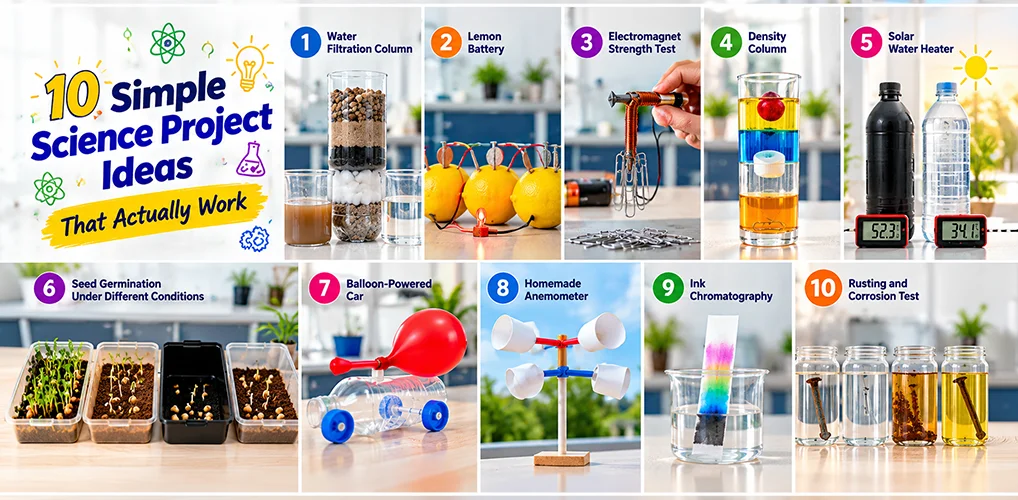
Most school science projects come together the night before submission, and they usually look it. The idea itself is rarely the problem. The problem is picking something the student cannot explain once a teacher starts asking questions.
The simple science project ideas below need materials from a kitchen shelf or a stationery shop, take a weekend at most, and each one rests on a concept that turns up again later in the syllabus. Simple and impressive are not opposites.
What Separates a Good Project From a Rushed One
Teachers look at three things: whether the student understands the principle, whether the result can be repeated, and whether it can be explained without reading off a board. A neat display cannot rescue a project the student cannot defend.
This is also why the most elaborate model is rarely the best one. A clean experiment on air pressure, done carefully and explained well, scores higher than a complicated build that a parent clearly assembled.
Science teachers at any Best CBSE School in Bangalore will say the same thing. They can usually tell within two follow-up questions who actually did the work.
10 Simple Science Project Ideas That Actually Work
1. Water Filtration Column
Layer cotton, activated charcoal, sand and gravel inside a cut plastic bottle, then pour muddy water through it. The water clears visibly. The useful part is explaining why the filter removes suspended particles but not dissolved salts.
2. Lemon Battery
Push a galvanised nail and a copper coin into each lemon, connect them in series, and light a small LED. Measure the voltage from one lemon, then from four, and record how it adds up. It is a working electrochemical cell, not a trick.
3. Electromagnet Strength Test
Wind insulated copper wire around an iron nail and connect it to a cell. Count how many paperclips it lifts at 20, 40 and 60 turns. The result gives you a real graph rather than a single demonstration.
4. Density Column
Pour honey, dish soap, water and oil slowly into a tall glass so they settle in layers, then drop in a grape, a bottle cap and a paper clip. Each object stops at a different level, which makes density visible instead of abstract.
5. Solar Water Heater
Fill two identical bottles with water, paint one black, and leave both in the sun. Record the temperature every fifteen minutes for two hours. The gap between the two readings is the entire point, and it is easy to plot.
6. Seed Germination Under Different Conditions
Set up four trays of chickpeas: plain water, salt water, full darkness and normal light. Count germinated seeds daily for a week. It teaches controls and variables better than most textbook explanations do.
7. Balloon-Powered Car
Build a small chassis from a plastic bottle and bottle caps, tape a straw and balloon to the top, and measure the distance travelled at three different balloon sizes. Newton’s third law, with numbers attached.
8. Homemade Anemometer
Fix four paper cups to two crossed straws and mount them on a pin so they spin freely. Count rotations per minute at ground level and on a balcony. Comparing two locations turns a model into an experiment.
9. Ink Chromatography
Draw a dot of black marker ink near the base of a filter paper strip and dip the very bottom into water. The dye separates into its component colours as the water rises, showing that most inks are mixtures.
10. Rusting and Corrosion Test
Place identical iron nails in dry air, tap water, salt water and oil, and photograph them daily for a week. The salt water nail rusts fastest and the oiled one barely changes, which explains oxidation and its prevention in one setup.
How to Turn a Demonstration Into an Investigation
Almost every idea above starts as a demonstration, which is the weaker version. The upgrade is small: change one thing, keep everything else constant, and record what happens.
The density column becomes an investigation once you test whether temperature changes the layering. The balloon car becomes one when you measure distance against three balloon sizes and plot the points. Nothing new needs to be bought.
This is also the difference examiners are trained to look for. A project that answers a question scores higher than one that shows an effect, even when the two use identical materials.
Matching the Project to the Class Level
The same project can be pitched at very different depths. What changes with the class level is how much measurement and analysis is expected, not the idea itself.
| Class Group | What Is Expected | Suitable Projects |
| Classes 4 to 6 | A clear demonstration and a simple explanation of what is happening | Density column, balloon-powered car, ink chromatography |
| Classes 7 to 8 | One variable tested, with observations recorded over time | Seed germination, electromagnet strength, rusting test |
| Classes 9 to 10 | Measured data, a graph, and a conclusion drawn from the readings | Solar water heater, lemon battery, water filtration column |
Several schools in north bangalore now run internal science fairs with separate judging criteria for each class group, which is a fair way to assess a Class 5 model and a Class 9 investigation without holding them to the same standard.
How to Present It Without Over-Explaining
State the question first, in one sentence, before describing anything you built
Show the setup, then the readings, in that order
Keep the display to a hypothesis, the method, one table or graph, and a conclusion
Bring the actual apparatus wherever it is safe and portable
Rehearse answering “what would happen if you changed this?”, because that is the question examiners reach for
Mention what did not work, since honest limitations read as understanding rather than failure
Mistakes That Cost Marks
The most common one is buying a ready-made kit and presenting it as original work. The second is running an experiment with no control, which leaves nothing to compare the result against.
A fourth, less obvious one is choosing a topic the student cannot connect to anything they have studied. A model volcano looks busy but explains very little, while a rusting test connects directly to a chapter on oxidation.
The third is writing a conclusion the readings do not support. If the solar heater gained four degrees, say four degrees. Many top schools in north bangalore now ask for a short process log alongside the project, partly to discourage last-minute outsourcing.
Where the School’s Role Comes In
Projects improve sharply when students have lab access outside class hours and a teacher willing to question the method early rather than grade it at the end. That support matters more than the size of the lab.
A number of international schools in bangalore have shifted to project work spread across a term instead of a single submission week, which gives students time to repeat a failed experiment rather than defend a rushed one.
Key Takeaways
A project is judged on understanding and repeatability, not on how elaborate the model looks
Everyday materials are enough for experiments on density, electricity, heat, and corrosion
Adding one measured variable turns a demonstration into a genuine investigation
Clear presentation, with a stated question and honest results, adds more marks than decoration
Starting early leaves room to repeat the experiment, which is where most of the learning happens
Conclusion
The best simple science project ideas for school students are the ones a student can rebuild from memory and explain to someone who was not there. That rules out most kits and almost everything assembled overnight.
Pick one concept, test it properly, record what happened, and be honest about the parts that did not work. That approach holds up in a Class 6 exhibition and in a Class 10 board practical equally well.
FAQs
1. How long does a simple science project take?
Most of the ideas here need two to four hours of building, though experiments involving germination or rusting need about a week of daily observation.
2. What materials should students avoid using?
Avoid open flames, mains electricity, and strong chemicals. Everything worth demonstrating at school level can be done with batteries, water, and kitchen materials.
3. Does a science project need a hypothesis?
From around Class 7 onward, yes. A stated hypothesis gives the results something to be measured against and makes the conclusion much easier to write.
4. Should parents help with the project?
Help with safety and materials is reasonable. Building it for the student is not, and teachers usually spot it during questioning.
5. Is a working model better than a chart or a report?
A working model scores better only if the student can explain the principle behind it. A well-documented experiment with data often beats a silent model.
6. What if the experiment does not produce the expected result?
Report what happened and explain why it might have differed. Unexpected results are acceptable in science as long as the method and reasoning are sound.