


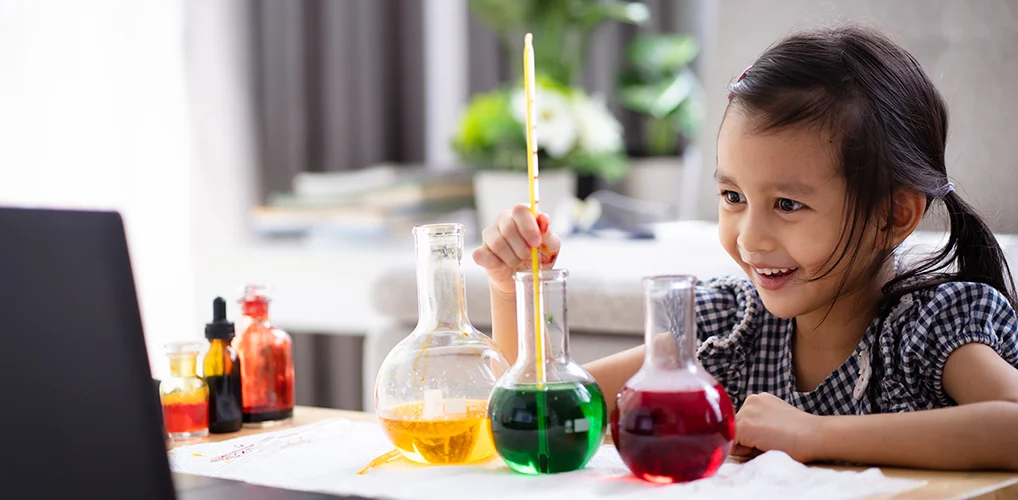
Ask a child why the sky is blue or why ice floats, and you will often get a string of follow-up questions. That curiosity is the best science tool there is, and it does not need a laboratory. Most of what a child needs is already in the kitchen.
This guide shares seven fun and easy science experiments for kids, each using safe household items. You will find the steps, the science behind the result and a few tips to help parents and teachers make the most of every experiment.
Why Science Experiments for Kids Matter
Hands-on experiments turn abstract ideas into things a child can see, touch and question. A chemical reaction in a bottle teaches more than a paragraph in a textbook, because the child watches it happen and wants to know why.
Regular experiments also build skills that last: observing carefully, predicting outcomes, recording results and accepting that a wrong guess is useful data. Many schools in north bangalore now build short practical sessions into the weekly timetable for exactly this reason.
Supplies to Keep Ready
You do not need to shop for a kit. A small box of everyday items is enough to start:
Baking soda, vinegar, salt and a lemon
Clear cups, a tall glass and a small plastic bottle
Food colouring, dish soap and cotton buds
Paper towels, white paper and a few balloons
Raisins, an egg and a shallow plate
Keeping these in one box means an experiment can start the moment a child asks a question, which is when interest is highest.
7 Easy Science Experiments for Kids You Can Do at Home
1. Baking Soda and Vinegar Volcano
Place two tablespoons of baking soda in a tall glass or small bottle. Add a few drops of food colouring, then pour in half a cup of vinegar and watch the foam rise. The acid in vinegar reacts with baking soda to release carbon dioxide gas, which creates the bubbles.
2. Dancing Raisins
Fill a clear glass with fizzy water or a clear carbonated drink and drop in a handful of raisins. After a minute, they begin to rise and fall. Gas bubbles cling to the rough surface of the raisins and lift them up. At the top, the bubbles pop and the raisins sink again.
3. Magic Milk
Pour full-fat milk into a shallow plate and add a few drops of different food colours. Touch the centre with a cotton bud dipped in dish soap, and the colours swirl away. The soap lowers the surface tension and breaks up fat in the milk, setting the colours in motion.
4. Walking Water
Line up three clear cups. Fill the outer two with coloured water and leave the middle one empty. Fold two paper towels and place each end in neighbouring cups. Over the next hour, water travels along the paper and fills the middle cup, a process called capillary action.
5. Self-Inflating Balloon
Pour a little vinegar into a bottle and spoon baking soda into a balloon. Stretch the balloon over the bottle neck, then lift it so the baking soda falls in. The carbon dioxide produced fills the balloon without a single breath.
6. Invisible Ink
Write a message on white paper using a cotton bud dipped in lemon juice and let it dry. An adult can then warm the paper gently near a light bulb. The acid in lemon juice weakens the paper, so it browns sooner than the rest and the message appears.
7. Floating Egg
Drop an egg into a glass of plain water and it sinks. Stir in several spoons of salt, and the egg rises. Salt water is denser than plain water, so it pushes up with greater force. This is also why it is easier to float in the sea.
Quick Comparison of the Experiments
Use this table to pick an activity based on time, difficulty and the concept it teaches.
| Experiment | Science Concept | Time Needed | Adult Help |
| Baking Soda Volcano | Acid-base reaction | 10 minutes | Minimal |
| Dancing Raisins | Gas and buoyancy | 10 minutes | Minimal |
| Magic Milk | Surface tension | 10 minutes | Minimal |
| Walking Water | Capillary action | 1 hour | None |
| Self-Inflating Balloon | Gas production | 10 minutes | Minimal |
| Invisible Ink | Oxidation and heat | 20 minutes | Needed for heating |
| Floating Egg | Density | 10 minutes | Minimal |
Families comparing good schools in north bangalore often notice how readily a school welcomes this kind of practical learning. Look for schools that let children test ideas themselves instead of only watching demonstrations.
What Children Learn from Each Experiment
Every activity above builds a slightly different skill. The volcano and balloon introduce chemical reactions, while the floating egg and walking water show how physical properties such as density and capillary action behave.
Magic milk and dancing raisins train careful observation, because the best details appear when a child watches closely and describes what changes. Invisible ink adds a dash of mystery that makes even reluctant learners want to try it again.
Safety Tips for Kids' Science Experiments
Even simple experiments need a few ground rules. Before starting, go through this checklist:
Always have an adult nearby, especially when heat or glass is involved.
Keep experiments away from the eyes and never taste anything unless told it is food-safe.
Wear old clothes and protect the table with newspaper or a tray.
Wash hands thoroughly after each activity.
Keep pets and younger siblings away from the work area.
How to Get More from Every Experiment
The real learning begins before and after the activity. Encourage children to follow a simple routine that mirrors how real scientists work:
1. Ask a question, such as what will happen if we add more salt.
2. Predict the result and write it down.
3. Run the experiment and observe carefully.
4. Compare the result with the prediction.
5. Change one thing and try again.
Do not rush to explain the answer. Letting a child form their own theory first leads to much deeper understanding. Parents shortlisting the top schools in north bangalore can ask about this very approach during a campus visit.
Turning Home Experiments into Lasting Interest
A child who enjoys these experiments can go further with a science journal, a visit to a planetarium or a science museum, or a small project for a school exhibition. Bangalore has several museums that make weekend learning easy.
A simple science journal helps here. Children can draw what they saw, note the date and write one sentence about why they think it happened. Looking back over a few weeks of entries shows them how much they have learned.
Consistency matters more than scale. One short experiment each weekend does more for a child than a large project once a year. Over time, the habit of asking why becomes part of how they think.
Experiment Ideas for Classrooms and Groups
These activities also work well for teachers and small groups. Split children into teams, give each team a different experiment and ask them to present what they saw and why it happened.
Group work teaches children to share ideas, listen to different explanations and respect each other's observations. It also turns a ten-minute experiment into a full lesson in communication.
Key Takeaways
Safe household items are enough for exciting experiments.
Each experiment links to a real science idea, from gas production to density.
Adult supervision and simple safety rules keep the activity enjoyable.
Predicting, observing and comparing results builds scientific thinking.
Regular practice matters more than complicated setups.
Conclusion
Science experiments for kids do not need expensive kits or special rooms. A bottle, a lemon and a curious mind are often all it takes to spark an interest that lasts for years.
Choose one experiment this weekend and let the questions flow. The best schools in north bangalore value exactly this kind of curiosity, and families can nurture it long before the school bell rings.
FAQs
1. What are some easy science experiments for kids?
The baking soda and vinegar volcano, dancing raisins, magic milk, walking water and the floating egg are all simple, safe and quick to set up.
2. Which age group are these experiments suitable for?
Most work well for children from about five to twelve years old. Younger children need close supervision, and older children can be asked to explain the science behind each result.
3. Are these experiments safe for children?
Yes, when done with adult supervision. They use common household items, but any step involving heat, such as invisible ink, should be handled by an adult.
4. How can I explain the science to a young child?
Use simple words and connect the result to something familiar. For example, say that the salt makes the water heavier, so it pushes the egg up.
5. Do I need special equipment?
No. Cups, plates, paper towels, baking soda, vinegar, salt and food colouring are enough for every experiment in this guide.
6. How often should kids do science experiments?
One short experiment a week is a good rhythm. It keeps interest high without feeling like homework.
7. How do experiments help in school learning?
They help children understand concepts rather than memorise them, and they build observation, reasoning and confidence in asking questions.